


Around the third month, many parents notice that their baby becomes more "present": they look for longer, smile back and start to show interest in what is going on around them. It is a good moment to add a few well-chosen toys to the play corner. Below we explain what a 3-month-old usually needs and what is worth offering.
What can a 3-month-old usually do?
Every baby develops at their own pace, and the skills below are only a rough guide. In most babies, a few changes can be seen around the third month:
- More focused looking – babies focus for longer and can usually follow a moving object.
- Discovering hands – they look at their hands, bring them together and often put them in their mouth.
- First "hits" – babies increasingly swing their arms towards hanging toys and bump them by chance.
- Better head control – during tummy time, babies usually lift their head for longer.
- Responding to sounds and faces – they turn towards voices, coo and smile at familiar people.
Deliberate grasping usually develops a little later, so toys for a 3-month-old should mainly be for looking, listening and batting – and only secondarily for holding.
Which toys work well for a 3-month-old?
Play arches and hanging toys for the pram and cot
These are some of the most useful toys at this stage. Hanging elements encourage babies to watch and reach out, and they learn that their movement causes an effect. The sensory play arch with sea animals and a mirror has a flexible frame and clips, so you can attach it to a pram, cot or car seat. The mirror, rattles and soft toys hanging from it stimulate sight, hearing and touch.
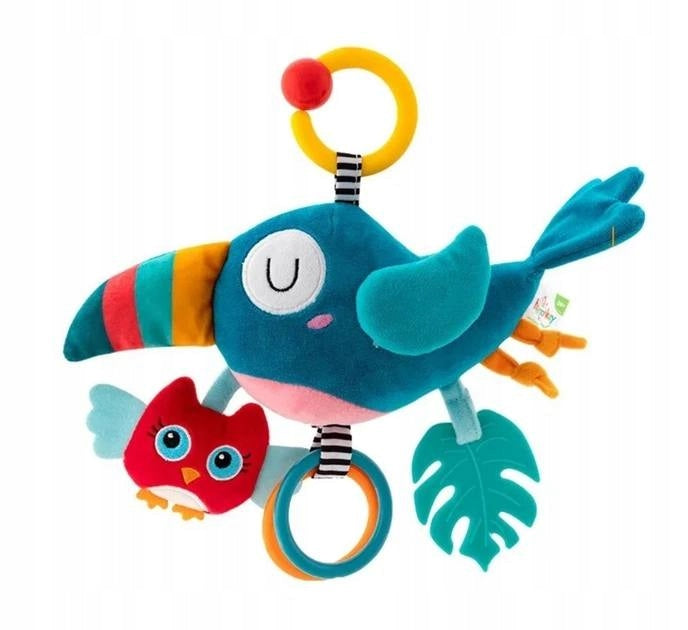
If you prefer something smaller, take a look at the Fox sensory hanging toy with a mirror – it combines soft materials, a safe mirror, rings and elements with different textures. You will find more models in our sensory hanging toys category.
Light rattles
Although a 3-month-old is only learning to grasp on purpose, a light rattle works well when playing together: you shake it to one side and your baby turns their head towards the sound. If you place it in their hand, they may hold it for a moment. The plush Fox rattle has a hammer-shaped handle, weighs 85 g and makes a gentle sound.
For babies from 3 months there is also the Baby Star rattle set – it includes a giraffe rattle, a small dumbbell rattle with beads, rings with stars for grasping and chewing, and a rattle with spinning beads, all made of BPA-free plastic. Other models are waiting in our rattles and teethers category.
Soft sensory books
A book is a great companion for tummy time. Opened in front of your baby, it gives them a reason to lift their head and look at the pictures, and crinkly pages add extra interest. The Crab sensory book has high-contrast animal illustrations, raised 3D elements, crinkly pages, a small rattle and a strap for the pram or cot. See our other sensory books too.
Toys with a mirror
Babies usually enjoy looking at faces, including their own reflection. A safe mirror – on a play arch, hanging toy or in a book – is a simple way to hold their attention for a while. Your baby does not recognise themselves yet, but watching a moving face is often fascinating.
Everyday play ideas
The best toys are the ones that involve your baby together with you. A few simple ideas:
- Tummy time with a book – place it in front of your baby and talk about the pictures.
- Find the sound – shake a rattle on the left, then on the right, and wait for your baby to turn.
- Batting at a hanging toy – hang a toy so your baby can reach it with a hand or foot.
- Mirror play – smile, make faces and name parts of the face.
- Rattle in hand – put a light toy in your baby's hand and let them feel it.
Play sessions should be short. When your baby turns away, fusses or rubs their eyes, it is a sign they need a rest. You do not need many toys – it is better to rotate a few from time to time than to show them all at once.
Toy rotation
A simple way to keep your baby curious is rotation. Keep two or three toys within reach and put the rest away for a few days. When they come back, babies often look at them with fresh interest. You can swap the pram hanging toy with the one from the play mat, or take the book from home on a walk.
Toy safety for a 3-month-old
At this stage almost everything goes into the mouth, so safety is essential:
- choose toys with CE marking that are intended for this age,
- avoid toys with small detachable parts,
- regularly check seams, fastenings and the condition of toys,
- wash toys according to the manufacturer's instructions,
- attach play arches and hanging toys securely, and keep cords and ribbons away from your baby's neck,
- never leave your baby alone with toys, and remove hanging toys from the cot at sleep time.
Toys for 3-month-olds at Plushyk
At Plushyk you will find Plush&K toys and other products for babies. Looking for inspiration? Browse our Montessori for babies and educational toys categories.
We ship from our warehouse in Poland – orders placed by 13:00 are dispatched the same business day. Delivery within Poland is free from 80 PLN, you get 10% off when you buy 3 toys, and you have 14 days to return your order. We also ship to EU countries (59 PLN).
Frequently asked questions
Does a 3-month-old need a lot of toys?
No. A few well-chosen toys are enough – for example a play arch or hanging toy, a light rattle and a soft book. Rotate them from time to time to keep play interesting.
Can a 3-month-old play with a teether?
Babies of this age often put their hands and objects in their mouth, so a soft or light teether designed for infants may interest them. Always check the age label and play under supervision.
How long should a 3-month-old do tummy time?
It usually starts with short moments several times a day that are gradually extended, always under adult supervision. If you have any doubts, talk to your paediatrician or a physiotherapist.
Are contrast toys still useful at 3 months?
Many babies are still interested in them, although they increasingly enjoy colours too. Toys that combine high-contrast patterns with colourful elements work well.

