
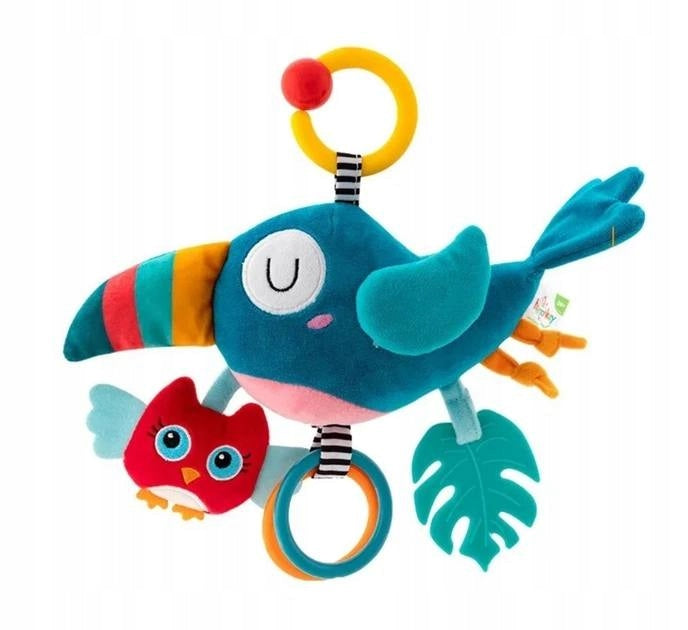


At first, a newborn's world is quite blurry – babies see best up close, and soft pastel colours tend to blend into the background. That is why many parents reach for high-contrast toys in the very first weeks. In this guide we explain when they make sense, which types are worth choosing and how to play with them safely.
Why do newborns like contrast?
Vision develops gradually after birth. In most newborns, sharpness of sight is still limited, and they see objects most clearly at a distance of about 20–30 cm – roughly the distance between a baby's face and a parent's face during feeding. Colour vision is also still developing, so bold combinations such as black and white, sometimes with a touch of red, catch their attention most easily.
Contrast toys do not "speed up" development in some magical way. They are simply matched to what a baby can see at this stage. This makes it easier for the little one to focus on them, and easier for parents to offer a short, calm play session during awake time.
When to introduce contrast toys?
You can start with black-and-white toys in the first weeks of life, whenever your baby has calm, alert moments. A few minutes is enough at first: show a card or toy up close, move it slowly to the side and watch whether your baby follows it with their eyes.
Interest in contrast is usually greatest during the first three months. Later, babies distinguish colours better and are more drawn to colourful toys, but black-and-white patterns often remain interesting – especially when combined with sound, crinkle or a mirror.
- 0–6 weeks – short close-up sessions with simple patterns: stripes, checks, circles.
- Around 2–3 months – more complex patterns, hanging toys above a play mat or in the pram, first attempts to bat at a toy.
- From around 3–4 months – contrast rattles and soft books that a baby can start trying to grasp.
Which contrast toys to choose?
Contrast cards and books
Soft books are one of the most versatile options. You can open one in front of your baby during tummy time or hang it in the cot or pram. One example is the high-contrast sensory book with a mirror – it features animals, the sun, the moon and geometric patterns, and its ties let you attach it to a cot, pram, car seat or playpen rail. You will find more ideas in our sensory books category.
Hanging toys and mobiles
A hanging toy above the play mat, in the pram or on the car seat gives your baby something to watch and, with time, something to bat at. The high-contrast sensory mobile has hanging plush animals in black and white with subtle accents and a handy attachment for a cot, pram, car seat or play arch. A simpler option is the high-contrast star hanging toy with a plastic clip. See the full range in our sensory hanging toys category.
Contrast rattles
A rattle combines sight and hearing: your baby sees a clear pattern and hears a sound when you gently move it. Over time, babies start grasping and shaking it themselves. The set of 2 contrast rattles is black and white with a colourful accent, made of soft fabric and makes a gentle sound. The high-contrast Teddy rattle comes with a strap, so it can be attached to a pram or car seat. Also take a look at our rattles and teethers category.
Soft sensory cubes
Once your baby becomes curious about what is lying next to them on the mat, a soft cube with bold patterns is a good choice. The Frog sensory cube has contrasting colours, animal and underwater motifs, different textures and crinkly elements, and every side looks different. It is light and soft, so over time your baby can try squeezing and turning it.
How to play with contrast toys
The most important rule: keep it short and calm, and play when your baby is well rested. Newborns tire quickly, and too much stimulation can make them fussy.
- Show it up close – hold the toy about 20–30 cm from your baby's face.
- Move slowly – move it left and right, giving your baby time to follow it with their eyes.
- Watch for cues – if your baby turns away, fusses or yawns, take a break.
- Use tummy time – an open book in front of your baby is a good reason to lift their head a little longer.
- Change patterns – show something new every few days to keep play interesting.
- Talk – name the shapes and describe what you see. Your voice and face matter to your baby just as much as the toy.
What to look for when buying
With toys for the youngest children, safety matters more than the number of features. Before you buy, check a few things:
- CE marking and age suitability – the toy should be labelled as suitable for children from 0 months.
- No small detachable parts – all elements should be securely sewn on or fixed.
- Pleasant materials – soft fabrics without sharp edges.
- Secure attachment – straps and ties should be fastened properly and not hang near your baby's neck.
- Easy cleaning – toys end up in the mouth quickly, so wash them regularly according to the manufacturer's instructions.
Also remember to check toys regularly for damage and never leave your baby alone with them. Remove hanging toys from the cot at sleep time.
Contrast toys at Plushyk
At Plushyk you will find Plush&K toys and other products for the youngest – from contrast rattles to hanging toys and books. To see more, browse our baby toys and Montessori for babies categories.
We ship from our warehouse in Poland – orders placed by 13:00 leave the same business day. Delivery within Poland is free from 80 PLN, you get 10% off when you buy 3 toys, and you have 14 days to return your order. We also ship to EU countries (59 PLN).
Frequently asked questions
Can newborns see colours?
Newborns still distinguish colours poorly, and colour vision develops gradually over the first months. That is why bold black-and-white patterns are the easiest way to catch their attention at first.
How long should I show contrast toys to my baby?
At first, a few minutes several times a day during calm, alert moments is enough. When your baby looks away or starts fussing, it is time for a break.
Until what age are contrast toys used?
They are usually most useful in the first three months, but many babies stay interested for longer. Contrast rattles and books often keep accompanying a baby who is learning to grasp.
Can I leave a contrast mobile in the cot overnight?
It is better to remove it at sleep time. Hanging toys are meant for supervised play, and the sleeping space should be free of unnecessary items.
